Conversion Rate Optimization (CRO)
Performance-first prompts and frameworks to improve conversion rate across landing pages, offers, checkout flows, CTAs, and A/B tests. Built for measurable lift in CVR, CPA, and revenue per visitor.
How AI Performance Prompts Help You Fix Low-Converting Landing Pages
Landing page optimization prompts help you move from “reporting” to decisions by forcing clarity, comparison, and next steps. Use this post as a prompt library you can reuse across accounts and platforms.

Table of Contents
Landing Page Optimization Prompts
If you have ever stared at your landing page analytics and felt confused, you are not alone. The page looks clean, the offer makes sense, the traffic is coming in, yet conversions stay stubbornly low. This is one of the most common frustrations in digital marketing, and it often leads people to chase surface level fixes instead of addressing the real problem. Many landing pages fail not because they are ugly or broken, but because they are unclear.
Visitors arrive with a specific question or need in mind, and the page does not answer it fast enough. When that happens, people bounce even if the product or service is actually a good fit. Clarity beats cleverness every time, yet clarity is surprisingly hard to achieve when you are too close to your own offer.
Another major issue is assumption based messaging. Page owners assume visitors already understand certain things. They assume users know what makes the offer different, why it matters now, or what happens after they click the button. These assumptions create friction. Every unanswered question becomes a reason to leave.
This is where traditional optimization advice often falls short. Generic tips like change the button color, shorten the copy, or add more testimonials can help, but only if they address the actual conversion barrier. Without diagnosing the real problem, you are just guessing. Guessing leads to endless tweaks without meaningful improvement.
AI performance prompts change this process by forcing structured thinking. Instead of asking AI to rewrite your landing page, you ask it to analyze, challenge, and stress test specific parts of the page. These prompts help surface blind spots that humans miss because of familiarity bias.
Low converting pages usually suffer from one or more of the following issues:
- A weak or unclear primary promise
- Messaging that focuses on features instead of outcomes
- Headlines that attract the wrong audience
- Too many competing actions
- Fear or uncertainty not being addressed
- Copy written from the brand perspective instead of the visitor perspective
- Lack of urgency or reason to act now
What makes AI performance prompts powerful is that they target these exact issues in a repeatable way. They act like a neutral reviewer who does not care about your attachment to the page. They only care about whether it works.
Instead of asking why your landing page is failing in a vague way, AI prompts help you ask sharper questions. They turn optimization into a diagnostic process rather than a creative guessing game. This shift alone can dramatically improve results, even before you rewrite a single sentence.
What AI Performance Prompts Are and How They Work in Practice
AI performance prompts are not magic commands that instantly fix your page. They are carefully structured instructions that guide the AI to analyze performance factors tied to conversion psychology. The key difference is intent. You are not asking the AI to sound better. You are asking it to perform better. A basic prompt might ask for a rewrite. A performance prompt asks for diagnosis, prioritization, and justification.
This distinction matters because most landing page problems are not about wording. They are about alignment between message, audience, and action. In practice, a performance prompt focuses on one variable at a time. Instead of dumping the entire page and saying fix this, you isolate elements such as the headline, hero section, call to action, or objection handling. This mirrors how professional conversion rate optimization works, but without needing a full team.
For example, rather than asking the AI to rewrite a headline, you might prompt it to evaluate whether the headline clearly communicates:
- Who the offer is for
- What problem it solves
- What outcome the user gets
- Why it is different from alternatives
The AI then responds with a critique, not just a rewrite. That critique often reveals missing pieces that were never obvious before. Performance prompts also help you step into the visitor’s mindset. AI can simulate different user personas and react to your page as if it were the first time seeing it. This is incredibly valuable because most page owners are incapable of seeing their own copy objectively.
Another advantage is speed. Traditional CRO requires surveys, heatmaps, user recordings, and multiple tests. Those tools are still valuable, but AI prompts allow you to quickly narrow down what to test first. Instead of testing ten ideas, you test two that actually matter.
Well designed AI performance prompts often do the following:
- Identify the most likely conversion blocker
- Explain why that blocker exists
- Suggest a change tied to user psychology
- Predict how the change might affect behavior
- Offer alternative variations based on different visitor motivations
This structured output is what separates performance prompts from generic content prompts. You are not replacing human judgment. You are enhancing it with faster analysis and pattern recognition.
It is also important to understand what AI performance prompts are not. They are not traffic generators. They do not fix a bad offer. They do not replace real user data. What they do is help you make better decisions with the information you already have.
When used correctly, these prompts act like a conversion focused checklist that adapts to your specific page instead of applying generic advice. Over time, this trains you to think more like a conversion strategist, not just a copywriter.
Using AI Performance Prompts to Diagnose and Fix Key Landing Page Elements
The real power of AI performance prompts shows up when you apply them to individual sections of your landing page. Each section plays a different role in the conversion journey, and each one can fail in different ways. Breaking the page down makes optimization more manageable and more effective.
Start with the headline and hero section. This area determines whether visitors stay or leave. A strong performance prompt here asks whether the headline passes the five second test. Can someone instantly understand what is being offered and why it matters? AI often reveals that headlines sound impressive but say very little. Words like ultimate, powerful, and next level feel persuasive but do not communicate value. A performance prompt pushes the AI to strip away fluff and evaluate meaning.
Next comes the supporting copy. This is where many pages overload the visitor with information. AI performance prompts can identify whether the copy answers natural follow up questions or jumps too quickly into features. Visitors want reassurance before details.
Common issues AI identifies in this section include:
- Explaining how before explaining why
- Using internal jargon
- Listing features without connecting them to outcomes
- Assuming trust instead of earning it
The call to action is another critical area. Many low converting pages have weak or confusing CTAs. AI performance prompts can analyze whether the CTA matches the stage of awareness the visitor is in. Asking for a big commitment too early often kills conversions.
For example, a prompt might ask the AI to evaluate whether the CTA feels safe, clear, and reversible. If clicking feels risky, users hesitate. The AI can suggest micro commitment alternatives that reduce friction.
Objection handling is where AI truly shines. Most page owners underestimate the fears and doubts in a visitor’s mind. Performance prompts ask the AI to list the top objections a skeptical user might have and whether the page addresses them clearly.
Typical objections include:
- Will this work for someone like me
- Is this worth the price
- What if it does not work
- How long will it take to see results
- Is this better than what I am using now
AI can flag which objections are missing or poorly handled and suggest where to address them. This often leads to higher conversions without adding more traffic.
Finally, flow and structure matter more than people realize. A performance prompt can analyze whether the page follows a logical persuasion sequence or jumps randomly between ideas. Even good copy can fail if the order is wrong.
By using AI prompts section by section, you turn a vague problem into a series of clear improvements. Each change has a reason behind it, which makes testing and iteration far more effective.
Turning AI Performance Prompts Into a Repeatable Conversion Improvement System
The biggest mistake people make with AI is using it once and moving on. The real value comes from building a repeatable system that improves every landing page you create. AI performance prompts are most powerful when they become part of your standard workflow.
Start by creating a prompt library. Instead of writing new prompts every time, save the ones that consistently deliver insights. Organize them by page element such as headline, offer, CTA, and objections. This turns AI into a consistent reviewer rather than a one time helper.
Next, use prompts before you publish, not just after performance drops. Running your draft through performance prompts before launch can prevent major issues from ever going live. This is especially useful if you launch pages frequently or work with multiple offers.
Another key habit is pairing AI insights with real data. If analytics show a high bounce rate, ask AI prompts focused on first impression clarity. If scroll depth is low, prompt the AI to evaluate engagement and pacing. This alignment makes AI feedback more actionable.
You should also use AI to generate test hypotheses rather than final answers. Let the prompts suggest why something might not be working and what to test. You still decide what goes live. This keeps you in control while benefiting from faster analysis.
Over time, you will notice patterns. Certain issues come up again and again. Weak differentiation, unclear outcomes, and mismatched CTAs are common culprits. AI performance prompts help you recognize these patterns faster and fix them earlier.
To make this sustainable, keep the process simple:
- Identify the underperforming metric
- Select the relevant page section
- Run targeted AI performance prompts
- Extract one or two clear improvement ideas
- Test and observe results
- Refine the prompt based on what worked
This loop turns AI from a novelty into a performance tool. It also reduces emotional attachment to your copy. When changes are driven by analysis instead of ego, results improve faster.
Low converting landing pages are frustrating, but they are rarely hopeless. Most of the time, they just suffer from unseen gaps in clarity, trust, or alignment. AI performance prompts help you see those gaps clearly and fix them with intention. When used thoughtfully, they do not replace strategy. They sharpen it. And in a world where small conversion improvements compound quickly, that edge makes all the difference.
Related Performance Prompts Guides
- Prompt Workflow for Improving Conversion Rates
- Performance Analytics Prompts for Quick Insight Extraction
- Performance Review Prompts to Audit Campaigns
External reference: For a practical, widely-used landing page speed and UX diagnostic, use PageSpeed Insights:
https://pagespeed.web.dev/
FAQs
What are landing page optimization prompts?
Landing Page Optimization Prompts are structured questions you can reuse to diagnose what’s happening, identify the most likely drivers, and produce testable next steps instead of generic advice.
How do I get better answers from AI?
Add context (platform, objective, timeframe, metrics), add constraints (what you can’t change), and ask for ranked hypotheses plus validation steps.
How often should I run these prompts?
Weekly works best: one diagnostic prompt, one exploration prompt, and one decision prompt. Consistency beats intensity.
What should I do with the output?
Turn outputs into small tests. Pick the top 1–3 recommendations, define success metrics, run controlled experiments, and document what you learn.
The Complete Prompt Workflow for Improving Conversion Rates
Conversion Rate Optimization Prompts
Conversion rate optimization prompts help you engineer clarity and momentum across your pages, ads, and emails—so more visitors take the next step instead of stalling out.
When people talk about conversion rates, the conversation usually drifts toward landing page colors, button placement, pricing psychology, or funnel hacks. Those things matter, but they often distract from the real engine driving results today. The quality of the prompts behind your content, offers, and decision paths is what shapes how clearly your message lands. Prompts decide whether your output feels intentional or random, focused or scattered, persuasive or forgettable.
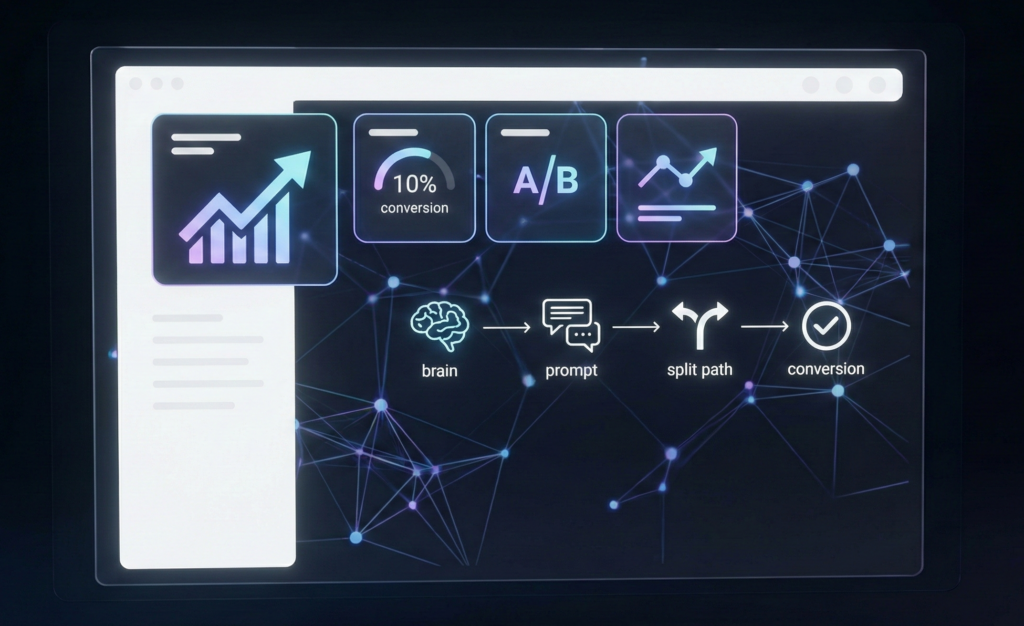
A conversion does not happen because someone clicked a button. It happens because a sequence of thoughts lined up in the reader’s mind. Every prompt you use, whether it is for writing copy, generating email sequences, creating product descriptions, or structuring offers, influences that mental sequence. Weak prompts create vague outputs. Vague outputs create confusion. Confusion kills conversions quietly and consistently.
Most creators and marketers treat prompts as one-off instructions. They open a tool, type something quick, get output, and move on. That approach produces content, but it rarely produces alignment. Conversion-focused work needs continuity. The prompt that generates your headline should connect logically to the prompt that shapes your body copy. The prompt that writes your call to action should understand the objections addressed earlier. Without a workflow, prompts fight each other instead of reinforcing the same decision.
A complete prompt workflow is not about writing longer instructions. It is about designing a chain of conversion rate optimization prompts that mirrors how a human makes decisions. People move from awareness to interest, from interest to trust, and from trust to action. Your prompts should follow that same rhythm. When they do, conversion rates stop feeling unpredictable and start feeling engineered.
Another hidden problem is prompt amnesia. This happens when you forget what the prompt was trying to solve in the first place. You ask for engaging copy, then switch to asking for persuasive copy, then jump to asking for urgency, without anchoring those prompts to the same audience state. The result is mixed messaging. One paragraph reassures while the next pressures. One section educates while the next assumes commitment. Readers feel that mismatch even if they cannot explain it.
Improving conversion rates means tightening the distance between intent and execution. Prompts are the bridge. A strong workflow forces you to clarify intent before you ever generate words. It asks questions like who this is for, what problem they believe they have, what outcome they want, and what fear is holding them back. Once those answers are locked in, every prompt downstream becomes sharper.
This is why conversion-focused teams obsess less over individual outputs and more over systems. They know that one good page does not scale, but a repeatable prompt workflow does. When your conversion rate optimization prompts are designed to work together, you are not guessing what might convert. You are building momentum step by step.
At its core, a conversion is a decision. Decisions happen when friction is removed and clarity is increased. A complete prompt workflow does exactly that. It removes friction from your creation process and injects clarity into the message your audience receives. That combination is what quietly but reliably improves conversion rates across platforms.
Quick-Start: Conversion Rate Optimization Prompts You Can Copy/Paste
Use these conversion rate optimization prompts to quickly tighten messaging, reduce confusion, and increase follow-through:
- Clarity check: “Rewrite this section so a distracted reader understands it in 5 seconds. Keep the same meaning.”
- Objection map: “List the top 7 objections a buyer might have after reading this page, then suggest one line to address each.”
- Message-match audit: “Compare this ad promise to this landing page. Identify mismatches and propose fixes.”
- CTA de-risk: “Rewrite the CTA to reduce hesitation. Include what happens next in one short sentence.”
- Benefit translation: “Turn these features into outcomes a customer can picture in daily life.”
- Friction hunt: “Identify the 5 places a reader might get confused or lose trust, and propose micro-edits.”
- Shorten without loss: “Cut this section by 25% while preserving all key points and keeping a confident tone.”
Building the Foundation Prompts That Shape Buyer Clarity
Every effective prompt workflow starts before you write anything that faces the audience. The foundation layer is internal. These prompts are not meant to generate publishable content. They are meant to shape understanding. Skipping this stage is the fastest way to create content that sounds polished but converts poorly.
Foundation prompts focus on three things: audience reality, problem framing, and desired transformation. These prompts should feel almost uncomfortable because they force specificity. If your answers feel generic, your conversions will be too. Strong conversion rate optimization prompts begin here—because the downstream copy is only as good as the upstream clarity.
A strong foundation prompt might ask you to define the audience in terms of behavior rather than demographics. Instead of age or job title, you focus on habits, frustrations, and patterns of avoidance. This matters because people do not convert because of who they are. They convert because of what they are stuck in.
Another foundational prompt should isolate the core problem from the surface symptoms. Many offers fail because they address what people complain about rather than what actually hurts. For example, someone may complain about low sales, but the deeper problem might be lack of trust or unclear positioning. Your workflow should force you to articulate that deeper layer before moving on.
Transformation prompts are equally important. These define what success looks like in the reader’s own language, not yours. Conversion improves when people can picture the after state clearly. If the transformation feels fuzzy, the decision feels risky. Foundation prompts should describe that outcome in practical, lived-in terms.
Here is what a solid foundation prompt set often includes:
- A prompt that describes the audience’s current situation on a bad day
- A prompt that identifies what they have already tried and why it failed
- A prompt that clarifies what they secretly hope will work
- A prompt that defines the emotional payoff of success
- A prompt that names the main fear or objection blocking action
These prompts are not glamorous, but they are powerful. They align your thinking before you ever ask for copy. When you later generate headlines, emails, or scripts, the output carries a consistent emotional logic because it all traces back to the same foundation.
Many creators rush past this stage because it feels slow. In reality, it saves time. Without foundation prompts, you end up rewriting endlessly because something feels off. With them, your first drafts are closer to the mark because the direction is clear.
Another benefit of strong foundation prompts is adaptability. Once you have them, you can reuse them across channels. A sales page, an email campaign, and a video script can all draw from the same core understanding. This keeps your messaging coherent, which is essential for improving conversion rates over time.
Think of foundation prompts as setting the rules of the game. They define what matters, what does not, and what outcome you are aiming for. Everything else in the workflow builds on this layer. Skip it, and you are guessing. Build it properly, and every prompt after becomes more effective.
The Conversion-Centered Prompt Flow From Attention to Action
Once the foundation is set, the workflow moves into execution. This is where most people start, but now you are entering with clarity. The goal here is to design prompts that guide the reader through a logical and emotional progression that ends in action.
A conversion-centered flow usually follows a consistent sequence: attention, resonance, credibility, resolution, and action. Each stage deserves its own prompt or set of prompts. Trying to compress everything into one instruction often produces shallow results. The best conversion rate optimization prompts separate these jobs on purpose.
Attention prompts focus on interruption. They are not about being clever but about being relevant. A strong attention prompt instructs the system to surface a specific pain point or moment of frustration the audience recognizes instantly. This creates the first micro-commitment: continuing to read.
Resonance prompts deepen the connection. These prompts ask for language that mirrors the reader’s internal dialogue. When done well, this stage makes people feel understood. Conversions increase when readers feel like the message was written for them, not for a general audience.
Credibility prompts establish trust without bragging. They guide the output to demonstrate competence through clarity, examples, or reasoning. This is where you address skepticism indirectly. Instead of claiming authority, you show awareness of nuance and trade-offs.
Resolution prompts introduce your solution as a logical next step, not a pitch. These prompts frame the offer as a response to everything discussed so far. The solution should feel inevitable, not forced.
Action prompts focus on reducing hesitation. They clarify what happens next, what is required, and what risk is minimized. Good action prompts avoid hype and instead emphasize ease and alignment.
To make this more concrete, here is a simplified table showing how a conversion-focused prompt flow maps to output intent:
| Stage | Prompt Purpose | Output Focus |
|---|---|---|
| Attention | Interrupt relevance | Specific pain or moment |
| Resonance | Build connection | Shared language and empathy |
| Credibility | Reduce doubt | Clear reasoning and insight |
| Resolution | Introduce solution | Logical fit and relief |
| Action | Enable decision | Clarity and reassurance |
What makes this workflow powerful is not the structure itself, but the discipline of separation. Each prompt has a job. When you let prompts bleed into each other, you confuse the reader. When each prompt does one thing well, the overall message feels smooth and intentional.
Another key principle here is constraint. Conversion improves when prompts limit scope. Instead of asking for everything, you ask for the next thing. This mirrors how people think. They do not decide all at once. They decide in increments.
This flow also allows for testing and optimization. If conversions drop, you can diagnose where the breakdown happens. Is attention failing? Is trust not being built? Is the action unclear? Because each stage has its own prompts, you can adjust without rebuilding everything.
A complete workflow does not lock you into one style or voice. It gives you a repeatable backbone. You can adapt tone, length, and format while preserving the same decision logic. That consistency is what compounds conversion improvements over time.
When your prompts follow a clear path from attention to action, you stop relying on luck. You start designing outcomes with conversion rate optimization prompts that work together.
Refinement, Testing, and Scaling the Prompt Workflow
The final section of the workflow is where most of the long-term gains come from. Refinement turns a good prompt system into a high-performing one. Testing reveals what actually moves decisions. Scaling ensures that improvements do not stay trapped in one asset or campaign.
Refinement starts with feedback loops. Instead of asking whether content is good, you ask where people disengage or hesitate. You then trace that friction back to the prompt that produced it. This shifts optimization from guessing to diagnosing, which is exactly what conversion rate optimization prompts are meant to enable.
One effective refinement method is prompt contrast testing. You generate two versions of the same stage using different prompt constraints. For example, one resonance prompt might emphasize emotional language, while another emphasizes practical outcomes. You then observe which version produces stronger engagement or conversions.
Another refinement tactic is simplification. As workflows mature, prompts often become bloated. Removing unnecessary instructions can actually improve output clarity. Conversion-focused prompts should be tight, intentional, and aligned with a single objective.
Testing does not require massive traffic to be useful. Even qualitative signals matter. Comments, replies, and direct feedback often reveal whether your prompts are producing clarity or confusion. Look for phrases like “this finally makes sense” or “I was already thinking this.” Those are signs the workflow is aligned.
Scaling is where many workflows break. People try to apply the same prompts everywhere without adjusting for context. A complete workflow scales by preserving logic, not wording. The foundation stays the same, but execution prompts adapt to format and platform.
Here are a few principles that help scale without losing conversion power:
- Keep foundation prompts constant across channels
- Adjust attention prompts to match platform behavior
- Shorten resonance prompts for fast-moving formats
- Maintain credibility prompts even in short content
- Always clarify the next action, even if it is small
Another important scaling consideration is team use. A documented prompt workflow allows multiple people to produce aligned content without constant oversight. This consistency builds brand trust, which indirectly boosts conversion rates over time.
As workflows scale, they also evolve. Market language shifts. Objections change. New competitors emerge. Periodically revisiting foundation prompts ensures that the system stays relevant. Conversion drops are often a sign that the foundation no longer matches reality.
The most mature prompt workflows feel invisible. They do not draw attention to themselves. They simply produce content that feels natural, persuasive, and easy to act on. That ease is not accidental. It is the result of deliberate design.
Improving conversion rates is rarely about finding a single magic phrase. It is about building a process that repeatedly produces clarity, trust, and momentum. A complete prompt workflow does exactly that. It turns conversion from a hopeful outcome into a predictable result driven by structure, intention, and refinement.
Related prompt libraries:
Split Testing Prompts,
Prompts to Lower CPA,
Facebook Ads Prompts
Helpful external references (dofollow):
Nielsen Norman Group,
Baymard Institute,
Google Analytics Help