The Complete Prompt Workflow for Improving Conversion Rates
Conversion Rate Optimization Prompts
Conversion rate optimization prompts help you engineer clarity and momentum across your pages, ads, and emails—so more visitors take the next step instead of stalling out.
When people talk about conversion rates, the conversation usually drifts toward landing page colors, button placement, pricing psychology, or funnel hacks. Those things matter, but they often distract from the real engine driving results today. The quality of the prompts behind your content, offers, and decision paths is what shapes how clearly your message lands. Prompts decide whether your output feels intentional or random, focused or scattered, persuasive or forgettable.
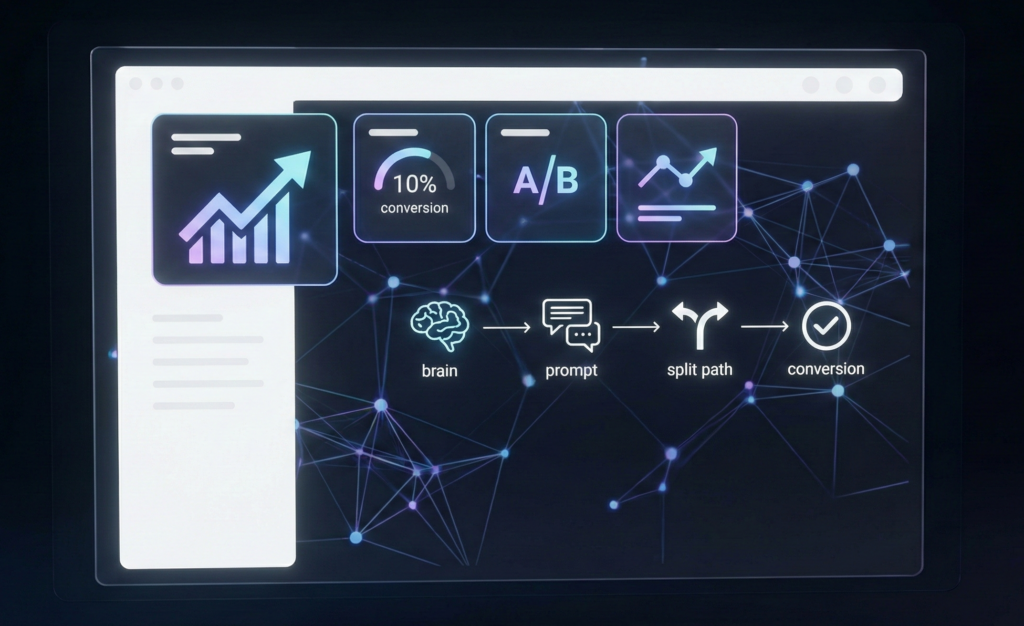
A conversion does not happen because someone clicked a button. It happens because a sequence of thoughts lined up in the reader’s mind. Every prompt you use, whether it is for writing copy, generating email sequences, creating product descriptions, or structuring offers, influences that mental sequence. Weak prompts create vague outputs. Vague outputs create confusion. Confusion kills conversions quietly and consistently.
Most creators and marketers treat prompts as one-off instructions. They open a tool, type something quick, get output, and move on. That approach produces content, but it rarely produces alignment. Conversion-focused work needs continuity. The prompt that generates your headline should connect logically to the prompt that shapes your body copy. The prompt that writes your call to action should understand the objections addressed earlier. Without a workflow, prompts fight each other instead of reinforcing the same decision.
A complete prompt workflow is not about writing longer instructions. It is about designing a chain of conversion rate optimization prompts that mirrors how a human makes decisions. People move from awareness to interest, from interest to trust, and from trust to action. Your prompts should follow that same rhythm. When they do, conversion rates stop feeling unpredictable and start feeling engineered.
Another hidden problem is prompt amnesia. This happens when you forget what the prompt was trying to solve in the first place. You ask for engaging copy, then switch to asking for persuasive copy, then jump to asking for urgency, without anchoring those prompts to the same audience state. The result is mixed messaging. One paragraph reassures while the next pressures. One section educates while the next assumes commitment. Readers feel that mismatch even if they cannot explain it.
Improving conversion rates means tightening the distance between intent and execution. Prompts are the bridge. A strong workflow forces you to clarify intent before you ever generate words. It asks questions like who this is for, what problem they believe they have, what outcome they want, and what fear is holding them back. Once those answers are locked in, every prompt downstream becomes sharper.
This is why conversion-focused teams obsess less over individual outputs and more over systems. They know that one good page does not scale, but a repeatable prompt workflow does. When your conversion rate optimization prompts are designed to work together, you are not guessing what might convert. You are building momentum step by step.
At its core, a conversion is a decision. Decisions happen when friction is removed and clarity is increased. A complete prompt workflow does exactly that. It removes friction from your creation process and injects clarity into the message your audience receives. That combination is what quietly but reliably improves conversion rates across platforms.
Quick-Start: Conversion Rate Optimization Prompts You Can Copy/Paste
Use these conversion rate optimization prompts to quickly tighten messaging, reduce confusion, and increase follow-through:
- Clarity check: “Rewrite this section so a distracted reader understands it in 5 seconds. Keep the same meaning.”
- Objection map: “List the top 7 objections a buyer might have after reading this page, then suggest one line to address each.”
- Message-match audit: “Compare this ad promise to this landing page. Identify mismatches and propose fixes.”
- CTA de-risk: “Rewrite the CTA to reduce hesitation. Include what happens next in one short sentence.”
- Benefit translation: “Turn these features into outcomes a customer can picture in daily life.”
- Friction hunt: “Identify the 5 places a reader might get confused or lose trust, and propose micro-edits.”
- Shorten without loss: “Cut this section by 25% while preserving all key points and keeping a confident tone.”
Building the Foundation Prompts That Shape Buyer Clarity
Every effective prompt workflow starts before you write anything that faces the audience. The foundation layer is internal. These prompts are not meant to generate publishable content. They are meant to shape understanding. Skipping this stage is the fastest way to create content that sounds polished but converts poorly.
Foundation prompts focus on three things: audience reality, problem framing, and desired transformation. These prompts should feel almost uncomfortable because they force specificity. If your answers feel generic, your conversions will be too. Strong conversion rate optimization prompts begin here—because the downstream copy is only as good as the upstream clarity.
A strong foundation prompt might ask you to define the audience in terms of behavior rather than demographics. Instead of age or job title, you focus on habits, frustrations, and patterns of avoidance. This matters because people do not convert because of who they are. They convert because of what they are stuck in.
Another foundational prompt should isolate the core problem from the surface symptoms. Many offers fail because they address what people complain about rather than what actually hurts. For example, someone may complain about low sales, but the deeper problem might be lack of trust or unclear positioning. Your workflow should force you to articulate that deeper layer before moving on.
Transformation prompts are equally important. These define what success looks like in the reader’s own language, not yours. Conversion improves when people can picture the after state clearly. If the transformation feels fuzzy, the decision feels risky. Foundation prompts should describe that outcome in practical, lived-in terms.
Here is what a solid foundation prompt set often includes:
- A prompt that describes the audience’s current situation on a bad day
- A prompt that identifies what they have already tried and why it failed
- A prompt that clarifies what they secretly hope will work
- A prompt that defines the emotional payoff of success
- A prompt that names the main fear or objection blocking action
These prompts are not glamorous, but they are powerful. They align your thinking before you ever ask for copy. When you later generate headlines, emails, or scripts, the output carries a consistent emotional logic because it all traces back to the same foundation.
Many creators rush past this stage because it feels slow. In reality, it saves time. Without foundation prompts, you end up rewriting endlessly because something feels off. With them, your first drafts are closer to the mark because the direction is clear.
Another benefit of strong foundation prompts is adaptability. Once you have them, you can reuse them across channels. A sales page, an email campaign, and a video script can all draw from the same core understanding. This keeps your messaging coherent, which is essential for improving conversion rates over time.
Think of foundation prompts as setting the rules of the game. They define what matters, what does not, and what outcome you are aiming for. Everything else in the workflow builds on this layer. Skip it, and you are guessing. Build it properly, and every prompt after becomes more effective.
The Conversion-Centered Prompt Flow From Attention to Action
Once the foundation is set, the workflow moves into execution. This is where most people start, but now you are entering with clarity. The goal here is to design prompts that guide the reader through a logical and emotional progression that ends in action.
A conversion-centered flow usually follows a consistent sequence: attention, resonance, credibility, resolution, and action. Each stage deserves its own prompt or set of prompts. Trying to compress everything into one instruction often produces shallow results. The best conversion rate optimization prompts separate these jobs on purpose.
Attention prompts focus on interruption. They are not about being clever but about being relevant. A strong attention prompt instructs the system to surface a specific pain point or moment of frustration the audience recognizes instantly. This creates the first micro-commitment: continuing to read.
Resonance prompts deepen the connection. These prompts ask for language that mirrors the reader’s internal dialogue. When done well, this stage makes people feel understood. Conversions increase when readers feel like the message was written for them, not for a general audience.
Credibility prompts establish trust without bragging. They guide the output to demonstrate competence through clarity, examples, or reasoning. This is where you address skepticism indirectly. Instead of claiming authority, you show awareness of nuance and trade-offs.
Resolution prompts introduce your solution as a logical next step, not a pitch. These prompts frame the offer as a response to everything discussed so far. The solution should feel inevitable, not forced.
Action prompts focus on reducing hesitation. They clarify what happens next, what is required, and what risk is minimized. Good action prompts avoid hype and instead emphasize ease and alignment.
To make this more concrete, here is a simplified table showing how a conversion-focused prompt flow maps to output intent:
| Stage | Prompt Purpose | Output Focus |
|---|---|---|
| Attention | Interrupt relevance | Specific pain or moment |
| Resonance | Build connection | Shared language and empathy |
| Credibility | Reduce doubt | Clear reasoning and insight |
| Resolution | Introduce solution | Logical fit and relief |
| Action | Enable decision | Clarity and reassurance |
What makes this workflow powerful is not the structure itself, but the discipline of separation. Each prompt has a job. When you let prompts bleed into each other, you confuse the reader. When each prompt does one thing well, the overall message feels smooth and intentional.
Another key principle here is constraint. Conversion improves when prompts limit scope. Instead of asking for everything, you ask for the next thing. This mirrors how people think. They do not decide all at once. They decide in increments.
This flow also allows for testing and optimization. If conversions drop, you can diagnose where the breakdown happens. Is attention failing? Is trust not being built? Is the action unclear? Because each stage has its own prompts, you can adjust without rebuilding everything.
A complete workflow does not lock you into one style or voice. It gives you a repeatable backbone. You can adapt tone, length, and format while preserving the same decision logic. That consistency is what compounds conversion improvements over time.
When your prompts follow a clear path from attention to action, you stop relying on luck. You start designing outcomes with conversion rate optimization prompts that work together.
Refinement, Testing, and Scaling the Prompt Workflow
The final section of the workflow is where most of the long-term gains come from. Refinement turns a good prompt system into a high-performing one. Testing reveals what actually moves decisions. Scaling ensures that improvements do not stay trapped in one asset or campaign.
Refinement starts with feedback loops. Instead of asking whether content is good, you ask where people disengage or hesitate. You then trace that friction back to the prompt that produced it. This shifts optimization from guessing to diagnosing, which is exactly what conversion rate optimization prompts are meant to enable.
One effective refinement method is prompt contrast testing. You generate two versions of the same stage using different prompt constraints. For example, one resonance prompt might emphasize emotional language, while another emphasizes practical outcomes. You then observe which version produces stronger engagement or conversions.
Another refinement tactic is simplification. As workflows mature, prompts often become bloated. Removing unnecessary instructions can actually improve output clarity. Conversion-focused prompts should be tight, intentional, and aligned with a single objective.
Testing does not require massive traffic to be useful. Even qualitative signals matter. Comments, replies, and direct feedback often reveal whether your prompts are producing clarity or confusion. Look for phrases like “this finally makes sense” or “I was already thinking this.” Those are signs the workflow is aligned.
Scaling is where many workflows break. People try to apply the same prompts everywhere without adjusting for context. A complete workflow scales by preserving logic, not wording. The foundation stays the same, but execution prompts adapt to format and platform.
Here are a few principles that help scale without losing conversion power:
- Keep foundation prompts constant across channels
- Adjust attention prompts to match platform behavior
- Shorten resonance prompts for fast-moving formats
- Maintain credibility prompts even in short content
- Always clarify the next action, even if it is small
Another important scaling consideration is team use. A documented prompt workflow allows multiple people to produce aligned content without constant oversight. This consistency builds brand trust, which indirectly boosts conversion rates over time.
As workflows scale, they also evolve. Market language shifts. Objections change. New competitors emerge. Periodically revisiting foundation prompts ensures that the system stays relevant. Conversion drops are often a sign that the foundation no longer matches reality.
The most mature prompt workflows feel invisible. They do not draw attention to themselves. They simply produce content that feels natural, persuasive, and easy to act on. That ease is not accidental. It is the result of deliberate design.
Improving conversion rates is rarely about finding a single magic phrase. It is about building a process that repeatedly produces clarity, trust, and momentum. A complete prompt workflow does exactly that. It turns conversion from a hopeful outcome into a predictable result driven by structure, intention, and refinement.
Related prompt libraries:
Split Testing Prompts,
Prompts to Lower CPA,
Facebook Ads Prompts
Helpful external references (dofollow):
Nielsen Norman Group,
Baymard Institute,
Google Analytics Help